The Reserve Bank will hold a special meeting of its rate-setting committee on November 3 to prepare a report for the government on why it failed to keep retail inflation below the target of 6 per cent for three consecutive quarters since January. The six-member Monetary Policy Committee (MPC) headed by RBI Governor Shaktikanta Das will prepare the report on reasons for failure to meet the inflation target as well as the remedial measures the central bank is taking to bring down prices in the country. "Under the provisions of Section 45ZN of the Reserve Bank of India (RBI) Act 1934... an additional meeting of the MPC is being scheduled on November 3, 2022," RBI said in a statement on Thursday.

Top laggards in the Sensex pack included Kotak Bank, ICICI Bank, HDFC Bank, Tata Motors, L&T, SBI, Tata Steel and Axis Bank, falling up to 3.46 per cent.
The RBI is not statutorily independent from the government but has long enjoyed wide latitude

'Normally, the system is geared towards counting notes -- it is equipped to do x amount of work and one day you are asking them to do 20 x.' 'The processes involved are very complex.'

The fifth meeting of Monetary Policy Committee maintained the repo rate, at which it lends to the banks, at 6.25 per cent and the reverse repo, at which it borrows, will be 6 per cent.

Jaitley said if interest rates were lowered, the economy could grow faster than 7-7.5 per cent.

CPI inflation will remain below the target of 6 per cent set for January 2016.
RBI policy, macro data, company earnings to decide market course this week: Experts
The SBI report ruled out a October rate hike
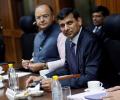
Balance is needed in selecting members for the proposed monetary policy committee, says Abheek Barua.

As COVID-19 infections spike in the country resulting in restrictions in various states and impacting the fragile recovery, many economists are expecting RBI to delay the policy normalisation move, which is expected in the February review. The country has reported a single-day rise of 58,097 new Covid-19 cases as of Wednesday morning--the highest in around 199 days -- of which 2,135 are Omicron cases and later in the day, the first confirmed Omicron-related death has also been reported. Maharashtra recorded the maximum number of 653 Omicron cases followed by Delhi at 464, Kerala 185, Rajasthan 174, Gujarat 154 and Tamil Nadu 121 cases, taking the total tally of cases to 3,50,18,358.

Rating agency Icra on Wednesday said while there is some evidence of the economic recovery becoming broad-based in the third quarter of fiscal 2022, it is yet to attain the durability being sought by the Monetary Policy Committee (MPC) as a precursor to policy transmission. The agency expects the real GDP to expand 6-6.5 per cent year-on-year in the third quarter of FY2022 (+8.4 per cent in Q2 FY2022). It also sees the RBI maintaining the status quo in the upcoming monetary policy review to be held in February.
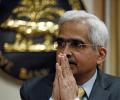
The RBI's rate-setting panel MPC on Monday began its three-day deliberation amid expectations of another round of hike in benchmark interest rates to contain inflation that continues to remain above the central bank's upper tolerance level. RBI Governor Shaktikanta Das will announce the decision of the Monetary Policy Committee after deliberations on Wednesday. Das has already indicated that there may another hike in the repo rate, though he refrained from quantifying it.

Reliance Industries was the top gainer in the Sensex pack, rallying nearly 4 per cent, followed by Infosys, Tech Mahindra, HCL Tech, TCS and L&T.
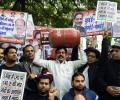
The rate of price rise for food articles stood at 11.51 per cent during January as against 2.41 per cent a month earlier, while for non-food articles it rose nearly three-fold to 7.8 per cent from 2.32 per cent in December, the data released by the ministry of commerce and industry on Friday showed.

Manufacturing activities in India touched a three-month high in March boosted by faster expansions in new orders and output amid demand resilience and easing of cost pressures, according to a monthly survey. The seasonally adjusted S&P Global India Manufacturing Purchasing Managers' Index (PMI) rose from 55.3 in February to 56.4 in March, signalling the strongest improvement in operating conditions in 2023 so far. The March PMI data pointed to an improvement in overall operating conditions for the 21st straight month.
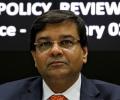
Market participants must appreciate that staying cautious is a virtue for central bankers and should not expect a sudden reversal in the formal monetary policy stance.

Dr Nagesh Kumar, one of the three new MPC members, wanted the MPC to reduce the repo rate by 25 basis points to 6.25%.

India's manufacturing sector activities witnessed the strongest rate of growth in three months in July amid improved demand conditions and easing of some local COVID-19 restrictions, a monthly survey said on Monday. The seasonally adjusted IHS Markit India Manufacturing Purchasing Managers' Index (PMI) rose from 48.1 in June to 55.3 in July, pointing to the strongest rate of growth in three months. In PMI parlance, a print above 50 means expansion while a score below 50 denotes contraction.

India's economic growth is estimated to have slowed down to 11-year low of 5 per cent during the current financial year ending March 2020.

Rajan said that even though inflation has breached the 6 per cent mark as against the RBI target of getting it down to 5 per cent by March 2017, the price rise scenario will ebb in future

The monetary authority said it was worried on three fronts with regard to inflation as well as the economy.
Monetary policy committee had recommended no change in the key rate.

The Reserve Bank is likely to maintain status-quo on the key interest rates for the third time in a row in its upcoming bi-monthly policy review despite the US Federal Reserve and the European Central Bank hiking benchmark rates, as domestic inflation is within the RBI's comfort zone, say experts. The borrowing cost which started rising in May last year has stabilised with RBI keeping the repo rate unchanged at 6.5 per cent since February when it was raised from 6.25 per cent. In the previous two bi-monthly policy reviews in April and June the benchmark rate was retained.

The Reserve Bank's rate-setting panel will start its 3-day deliberations on Wednesday amid expectations of yet another rate hike of 50 basis points to check high inflation, in line with similar actions taken by other major central banks, including the US Fed. Based on the recommendations of the Monetary Policy Committee (MPC), the RBI had effected 50 basis points increase in repo rate each in June and August after raising the short-term lending rate by 40 basis points in an off-cycle decision in May. The MPC, headed by RBI Governor Shaktikanta Das, is scheduled to meet during September 28-30.

'The actions of Indian monetary authorities will depend on how quickly they want the inflation to come down to 4 per cent.'

India's headline retail inflation is expected to moderate further in the months to come, as low wholesale inflation will transmit to consumer prices, the Ministry of Finance said in its latest monthly economic review (MER) on Monday. "Inflationary pressures eased in February, with slight moderation in Consumer Price Index (CPI) inflation and Wholesale Price Index (WPI) inflation softening to a 25-month low. "With WPI inflation easing, its transmission to CPI inflation is soon expected," the MER for February said.
'The central bank has highlighted that the slowdown in growth has been limited to a few sectors and overall growth is expected to pick up in the second half of the year.'

Consensus among members at April policy meet that rupee be allowed to depreciate

Global trends, macroeconomic data, and the outcome of the US Fed policy meeting are the major factors that will drive the movement in the domestic equity markets this week, analysts said. "In the upcoming data-centric week, the focus will be on crucial releases, including inflation data from India and the US. "Indian inflation is expected to rise, while US inflation will remain steady.

A weak dollar overseas also aided the rupee rise while fresh sell-off by foreign funds in domestic stocks capped the currency's gains, forex dealers said.

"Finance Ministry and RBI keep talking all the time," Rajan said.
Most members of the monetary policy committee (MPC) argued for front-loading interest rate hikes in view of rapidly rising inflation during the off-cycle monetary policy review earlier this month - the minutes of the meeting published on Wednesday showed. In early May, the rate setting committee met unscheduled and unanimously decided to hike the repo rate by 40 bps. This was the first repo rate hike in four years, and an inter-meeting hike in more than a decade.
Governor Urjit Patel and his deputies spoke to the media about the central bank's decision to raise the repo rate.

The repo rate, at which the central bank lends to the system, will come down to 5.75 per cent after the cut.
The uncertainty created by the jump in COVID-19 infections and localised lockdowns prompted RBI Governor Shaktikanta Das and other members of the rating setting panel MPC to unanimously vote for status quo in interest rates and an accommodative policy stance to support growth, as per minutes of the meeting released on Thursday. "The need of the hour is to effectively secure the economic recovery underway so that it becomes broad-based and durable," the Governor said during the three-day meeting of the Monetary Policy Committee (MPC) which ended on April 7. The renewed jump in COVID-19 infections in several parts of the country and the associated localised and regional lockdowns add uncertainty to the growth outlook, he observed, as per the minutes of the meeting released by the central bank.

India's services sector remained in contraction territory for the third straight month in July, as business activity, new orders and employment declined further largely due to the COVID-19 pandemic and local restrictions, a monthly survey said on Wednesday. The seasonally adjusted India Services Business Activity Index rose from 41.2 in June to 45.4 in July, but was stuck in the red due to subdued demand conditions amid the COVID-19 crisis. In Purchasing Managers' Index (PMI) parlance, a print above 50 means expansion, while a score below 50 denotes contraction.

The repo rate, at which the central bank lends short-term money to other banks, will continue to stay at 6 per cent.

Exactly a fortnight ahead of the Reserve Bank of India's (RBI's) next monetary policy review, a key market indicator of interest rates - the overnight indexed swap (OIS) - suggests that the central bank may tighten policy by 35 basis points and then refrain from further rate hikes. RBI Deputy Governor Michael Patra recently described the OIS as the primary instrument for hedging interest rate risk in India. The six-member Monetary Policy Committee (MPC) of the RBI will meet on December 5-7.
It further pointed out that the twin balance sheet problem -- at the end of banks and corporate -- more attractive interest rates for borrowers in the bond market and from non-banking financial institutions are other reasons for slow bank credit growth.
